



Semiconductor investing was once a category left to a small group of specialists, considered too cyclical, technical, and esoteric for most. Now, AI has funneled attention and capital into a market that is faster-moving and noisier than ever. This colossal new demand is changing the customer set, the potential size of exits, and what it takes to build a successful company.
At Deep Tech Week San Francisco, I moderated a discussion with three longtime semis investors: Kike Miralles of Intel Capital, Manish Muthal of Maverick Silicon, and Adit Singh of Cota Capital. Central to our discussion was which of these changes will remain and which are a product of the moment.
You can check out the full discussion on YouTube or a summary of some of the main takeaways below.
The Opportunity Around the Processor
The first wave of investment in AI infrastructure was all about compute, and more specifically GPUs. Companies competed to build and market the largest possible clusters of GPUs. For the first time ever, prospective hires asked companies how many GPUs they had available when evaluating jobs.
Manish describes Maverick’s pull-through thesis and focus on the opportunities around the compute. AI is a fundamentally different workload with exponentially growing compute intensity. As that happens, everything around the compute must also adapt to this new paradigm, from networking to storage, memory, security, and power delivery. These rapid market shifts can put startups on the same footing as incumbents and create opportunities for VC investment.
The complication with rising spending on AI CapEx is that scaling hardware relies on complex supply chains and an ecosystem of components and processes vulnerable to bottlenecks. HBM supply and CoWoS advanced packaging capacity have both been highly visible examples.
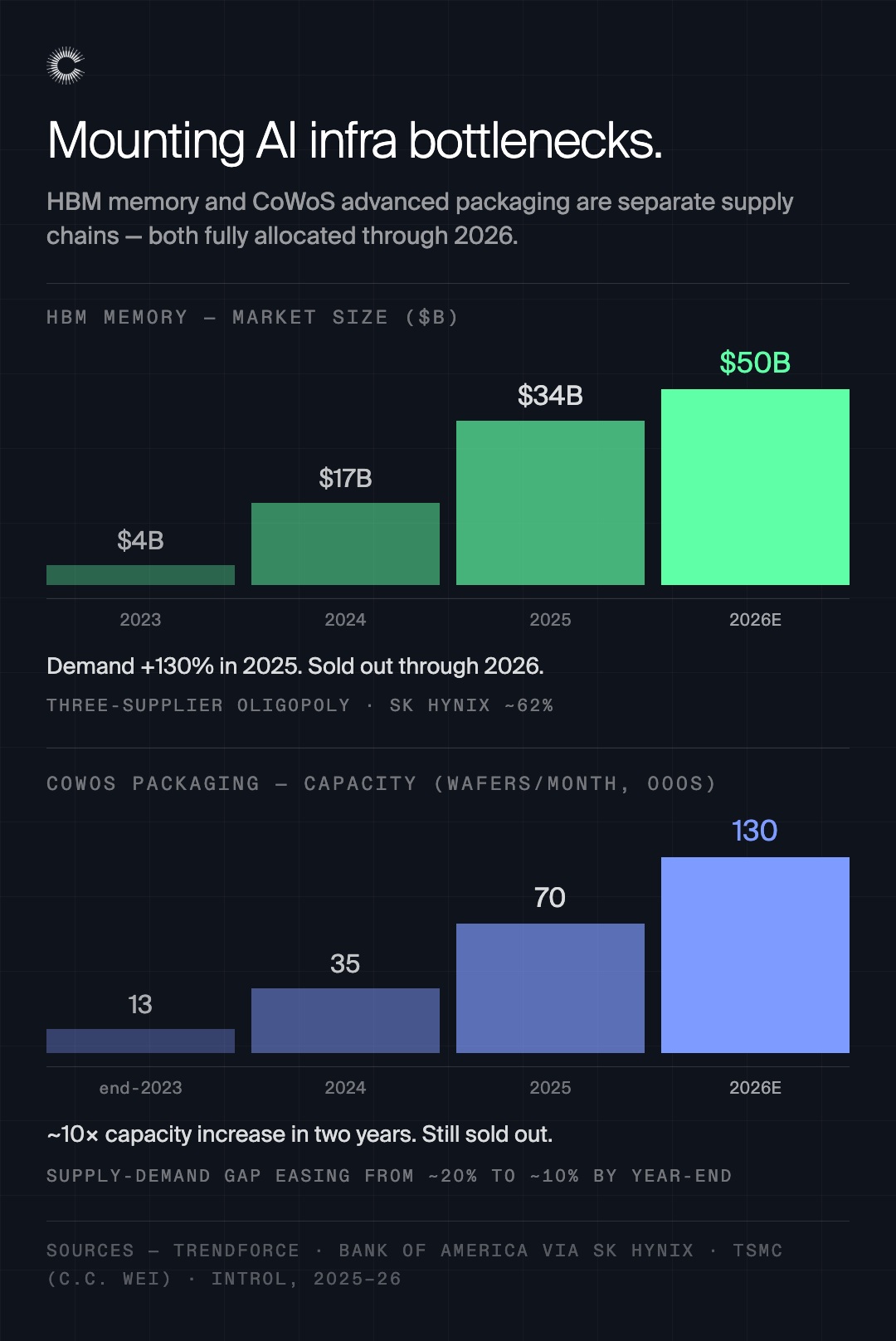
Much attention and discourse in public markets has centered around finding and investing in these bottlenecks. Both Kike and Manish highlight their mutual portfolio company Mueon as a counterexample to this approach. Mueon avoids the need for HBM by tightly integrating compute, memory, power delivery, and thermal management. A good reminder that bottlenecks can be overcome not only by scaling supply, but also by redesigning systems.
The Difference Between Early and Too Early
A unique aspect of semiconductors is that technology roadmaps are relatively public years in advance. Investors can look at technologies like glass substrate or co-packaged optics and see plans well in advance of production. Waiting for revenue to ramp can mean missing the early stage of a company altogether. But, investing too early risks backing a science project that never matures. Kike frames it as investing early enough that the technology is available when the problem is urgent, while ensuring that the point of urgency is within sight. Strategic investors like Intel Capital can be valuable partners in bridging the gap between companies’ internal and external messaging on timing.
Selling the Solution
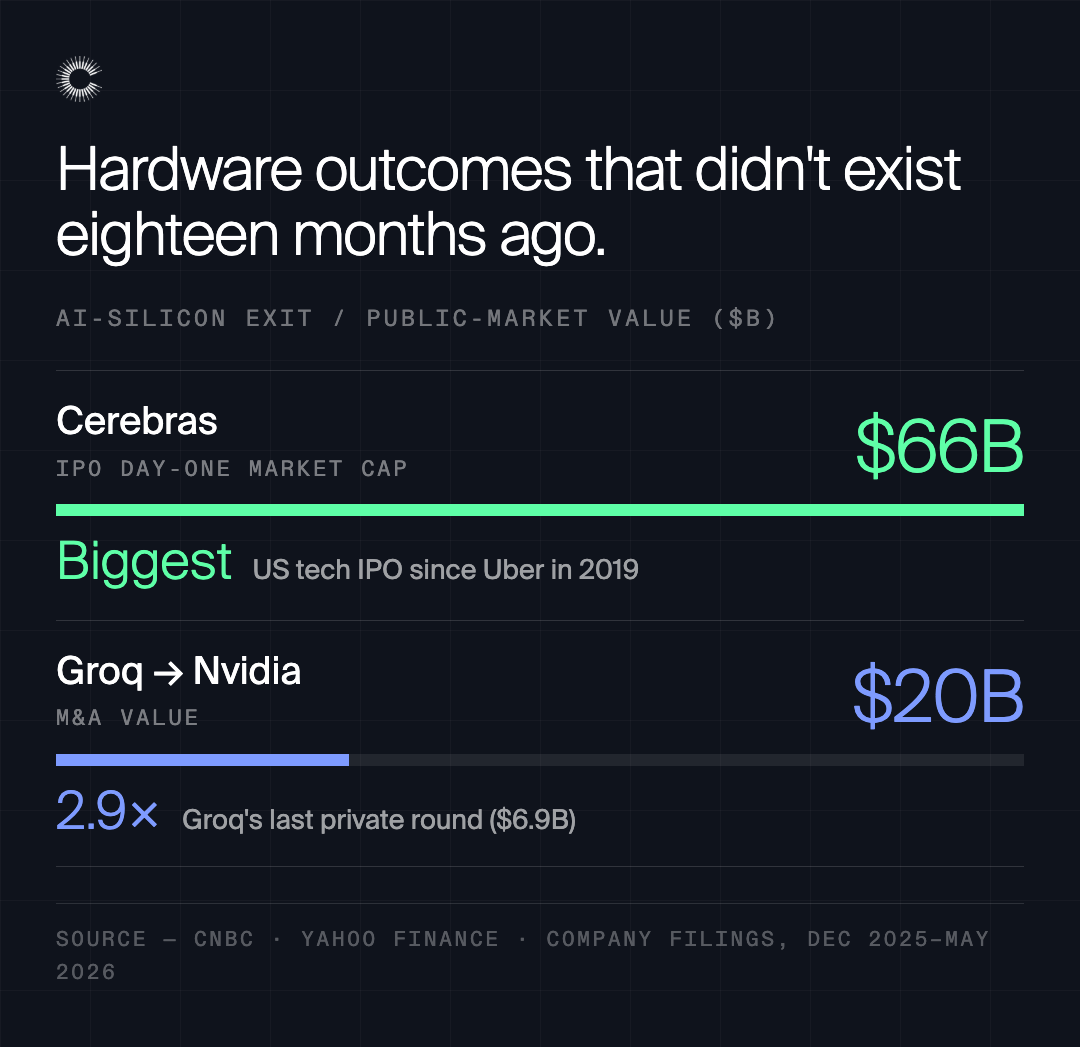
Adit invested early in Cerebras while at Foundation Capital and admits the size of the upside surprised even him. Though the company didn’t have revenue for the first five years, they came to realize that customers want to buy inference, not chips. This solutions-based thinking eventually helped Cerebras achieve one of the largest IPOs of all-time.
Resizing Exits
The large exits for Cerebras and Groq investors are forcing traditional semiconductor investors to reevaluate how big outcomes can be. There were assumptions about likely acquirers and the ceiling on valuation. Now long-time investors must consider whether the market has truly changed or we are in a transitory period of exuberance.
NVIDIA’s Advantage Beyond CUDA
Today in the back half of 2026, the major AI labs are all using at least one custom ASIC and one of the biggest IPOs was an Nvidia competitor, Cerebras. This hints that the CUDA software ecosystem is no longer an impenetrable moat. Yet Nvidia just put up another blowout quarter.
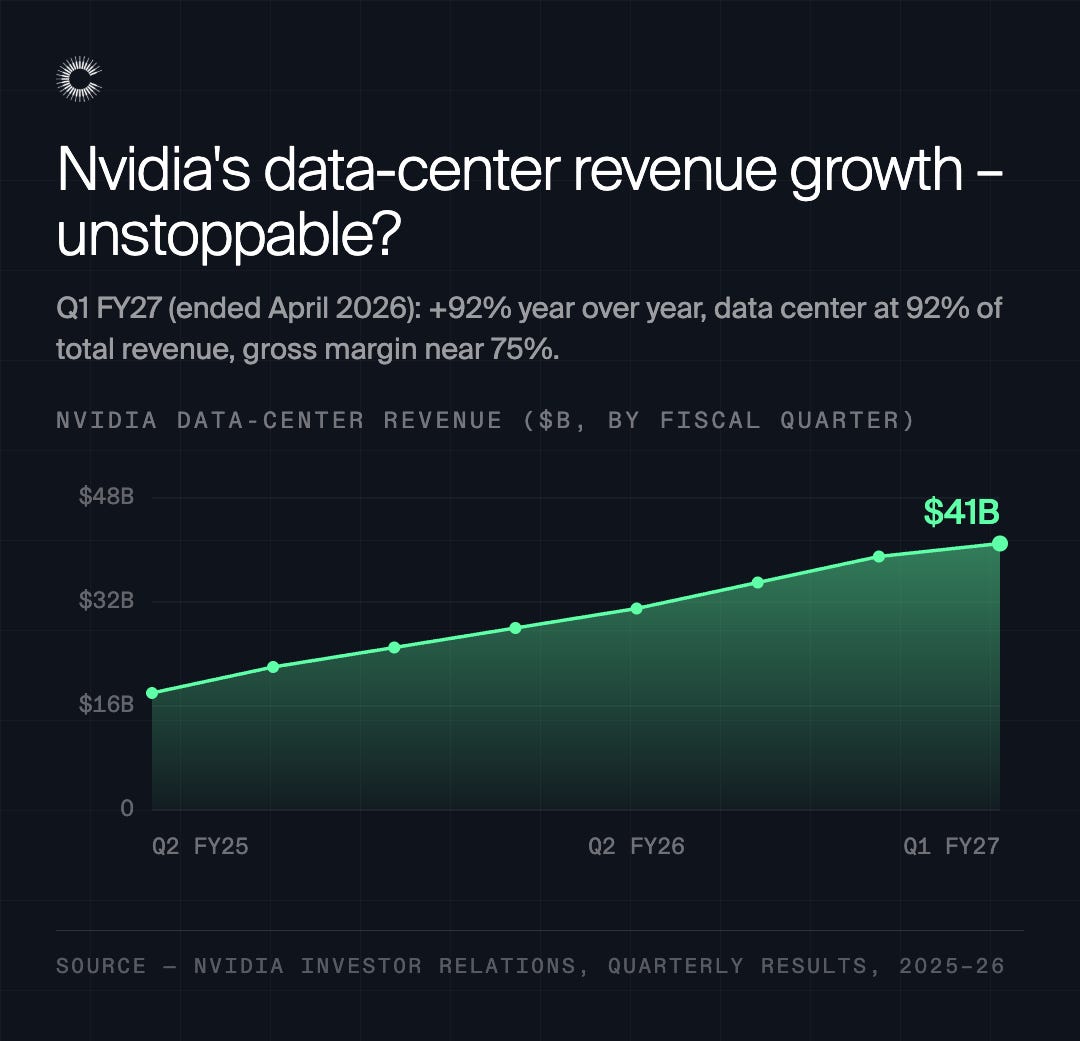
The CUDA moat is still significant in training where Nvidia continues to dominate market share. Training runs are expensive, complex, and highly optimized around the Nvidia architecture already. Inference is more directly tied to revenue and cost, and therefore optimizing tokens per dollar or watt translates into profitability. This drives a greater interest in experimenting with alternatives.
Nvidia’s advantage is also not limited to CUDA. Their ability to deliver full systems optimized at the data center level makes deployment easier and quicker for customers.
The Sovereign Buyer
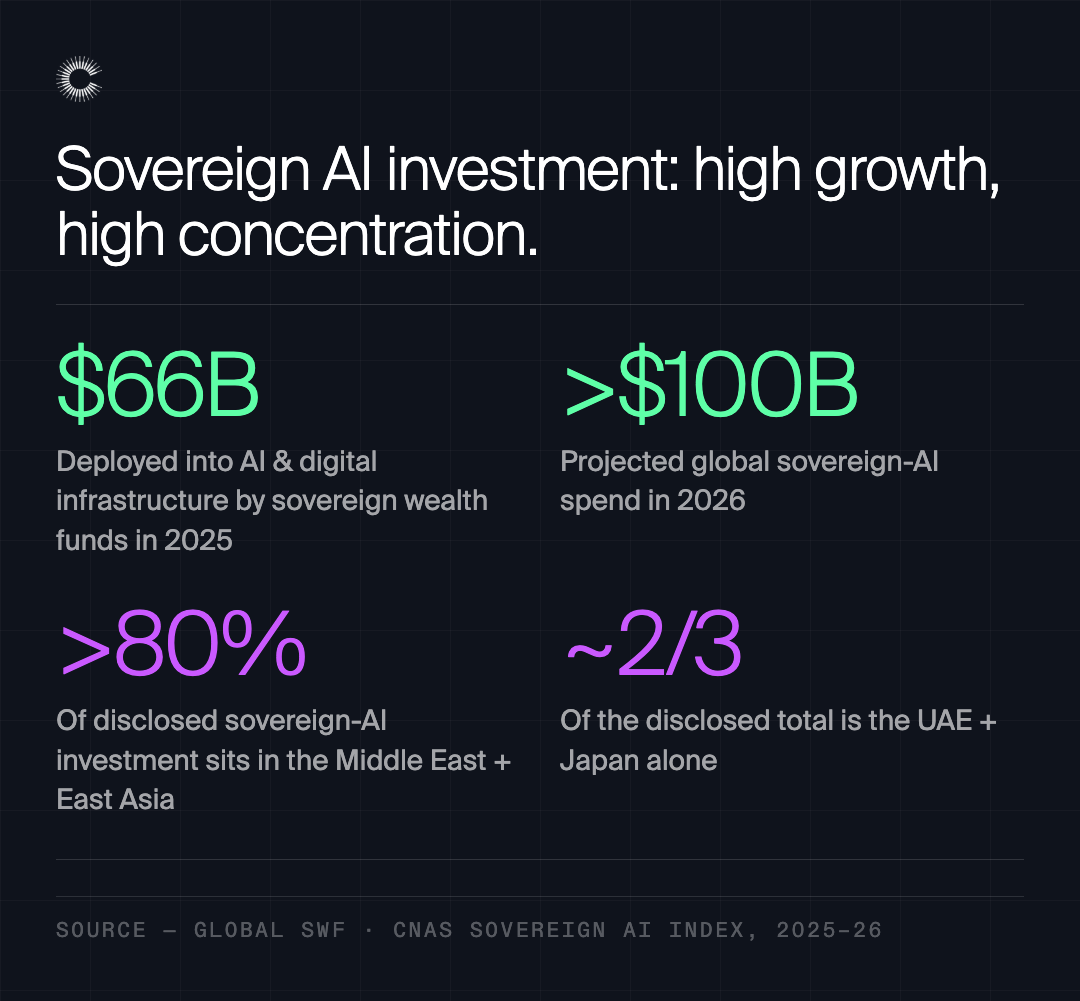
The customer set is changing too. Governments are buying their own AI infrastructure and supporting national champions. AI is such a critical underlying technology that nation-states cannot risk cutoff because of export controls or losing authority over their sensitive data. China has a large enough domestic demand and technology base to build an independent ecosystem. Others find themselves trading off between control and staying at the cutting edge.
What struck me most in this conversation was how quickly so many preconceptions about semiconductor investing have shifted. How early is too early? What makes a moat? How big can an outcome get? Who are the most important customers? Returns over the next few years will go to the investors who can correctly discern between the structural changes and the transitory ones.
David Goldman is a Partner at Celesta Capital, a deep tech venture capital firm based in Silicon Valley.